Case study · DADO
DADO: designing luxury gifting from zero to launch
Outcome
150+ flows across three products.
What is DADO
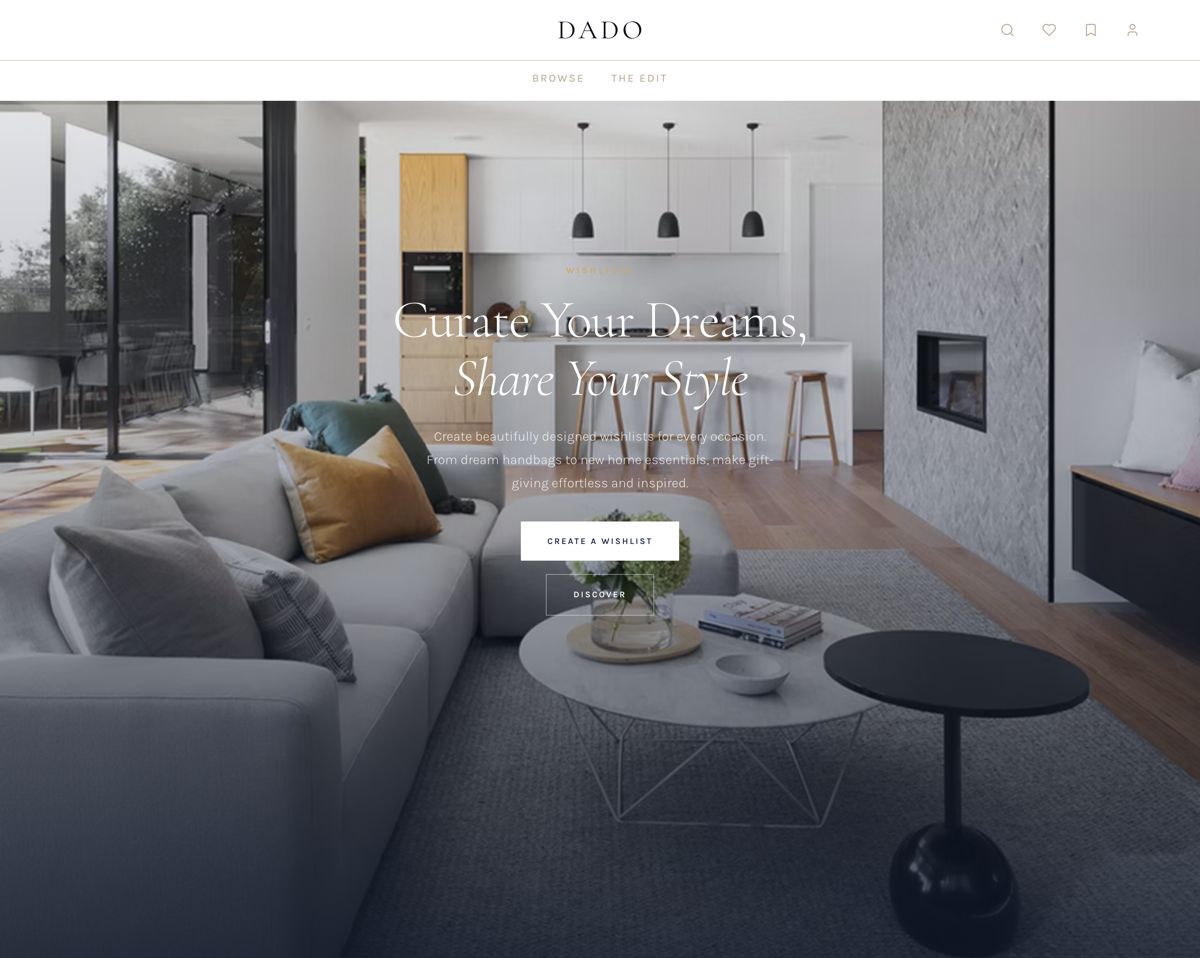
DADO is a luxury gifting platform. You browse gifts the way you would read a magazine, save what you like to a wishlist, and choose who can see each item on it. When a gift costs more than one person wants to spend, a group can put money toward it together. Three parts do that work: The Edit for browsing, Accounts for wishlists and privacy, and One Big Wish for group gifting.

The live homepage. The promise comes before anything is for sale.
Role
UX Designer, owning product end to end
Timeline
Jul 2026 – present · 0 → 1 → launch
Tools
Figma, React, TypeScript, Tailwind, Asana
The challenge
Gift apps ask people to trust them with three things at once: money, a surprise, and someone else’s private details. DADO adds a fourth: it has to feel expensive. So every screen has to look careful, and when something goes wrong it must not damage a friendship.
The solution
We ask permission before anything is shared, everywhere in the product. We wrote one design system and made the code follow it. We built the testing from scratch. Three products shipped, on a map of more than 60 magazine pages and more than 20 gift categories.
150+
flows shipped across the site
308
test cases, in nine sections
60+
pages in the magazine section, in 20+ categories
How we built it, from plan to live.
Every product here was built the same way. It starts as a written plan. The plan turns into user flows, and we shipped more than 150 of them. The flows sit on a map of the site: over 60 pages in the magazine section, sorted into more than 20 gift categories.
Only then do we draw screens. Rough sketches first, then wireframes, then the finished design on the design system. We build them in code ourselves, so nothing sits in a queue waiting to be handed to someone else. That is the only reason this much ground could be covered.
Accounts: who can see what.
Accounts holds a person’s profile, wishlists, gift history and sharing settings. You choose who can see each item, one item at a time, across four levels of audience. The same rule is applied on the screen, in the database, in wishlists, in gift history and on every shared link. A privacy rule that only exists on screen leaks. This one is checked everywhere the data goes.
Nobody is added to an occasion without agreeing to it first. And when a child turns eighteen, their gift history moves to them, with prices and private notes removed for good.
Wishlists on the live site. This is where the sharing rules apply.
One Big Wish: group gifting with real money.
Friends put money toward one big gift. The person setting it up walks through six steps. The people giving walk through four. Cards are saved with Stripe.
Nobody is charged when they promise money. The card is checked and held, not taken. We send an email to say so. The real charge happens seven to ten days before the day of the gift. The money moves when the gift is about to be real, not while everyone is still excited.
If the group falls short, we do not hand the money back. It still has to end in a gift. The person who asked for it picks one of two things: pay the rest themselves, or take what was raised as a digital gift card. The claim only works from the account that set the wish up, and the server checks that every time, so the card cannot reach anyone else.
When a gift goes wrong, a relationship is on the line.


Setting up a wish: the details, the full cost, and the moment it goes live. These come from the design file, because this part needs a sign-in.
The Edit: luxury you can browse.
The Edit is the magazine side of DADO: more than 60 pages, sorted into more than 20 gift categories. It is built so that browsing feels like reading, and still ends on something you can actually buy. Every page uses the same design system, so the whole thing feels like one place.


Gifts sorted by occasion, and the Presents page that leads into the guides.
A design system the code has to follow.
We wrote the whole design system in Figma: colours, type sizes, spacing, screen sizes, and the email templates. We wrote down the accessibility standard too, and applied it across the product.
Then we turned it into a written rulebook. The build has to follow it before anyone touches the product: two typefaces and never a third, a fixed set of colours, no rounded corners by default, and a list of things that must never be done. Design review starts from already consistent, because the rules are applied while the work is made, not after it.
The type scale
Display LG · 72/79
The Gift of Being Known
H1 · 48/53
Every milestone, beautifully celebrated
Eyebrow · 12/18
WEDDING SEASON
Body M · 16/22
Your card is authorized now and charged when the wish closes.
The closed palette, and the six occasion hues
Surface 01
Surface 02
Border
Taupe Deep
Primary CTA
Midnight
Birthdays
Anniversaries
Milestones
Cultural
National
Personal
The same design system, written once for people and once for the code.
The testing setup, built from scratch.
Products break in the joins between features, so we built the thing that finds those breaks: a test workbook with 308 cases in nine sections, run by eight testers. An earlier version had 144 cases. We rebuilt it around the real pages in the code, so saying something was covered actually meant something.
Bugs come in through a form in Asana. The form makes a task and sends it to the right developer, so a bug’s whole life, from found to fixed, sits in one place.
Where things landed.
It is early. There are no public numbers to share yet.
These are the numbers we would watch first. How many wishes each active person makes. How many group gifts get paid in full, which is the real test of One Big Wish. And how often a group falls short, because that tells us how much the backup plan matters.
Reflection
This was the widest brief we have worked on: design, deciding what came next, testing and tooling, all at once. The lesson so far is that at a young startup the design system, the test workbook and the roadmap are not three jobs. They are one job: agreeing what finished means before anyone argues about it.
DADO, 2026. Product design and front end engineering by Manish Durgude.