NurseShift
AI-Assisted Nurse Handoff Workspace
Overview
NurseShift is a clinical nurse handoff management system designed for hospitals. It streamlines the shift-to-shift communication between nurses using AI-powered handoff summaries, real-time patient tracking, and role-based access controls to protect sensitive Protected Health Information (PHI).
Timeline
November 2025 - January 2026 (3 months)
Team
Manish (Me), Anchal & Atharva
The Problem
Hospital handoffs promise continuity of care but rely on fragmented notes and memory, turning shift changes into high-risk moments for patient safety.
Patient handoffs that happen dozens of times per week, often rely on fragmented notes and memory during shift changes marked by time pressure, fatigue, and constant interruptions. When this exchange is unstructured, critical priorities become unclear for incoming nurses and invisible to leadership, increasing the risk to patient safety.
Fatigue

Risk
Overload
Inconsistency
Fragmentation
Inefficiency
Design Challenge
How might we help nurses deliver complete, prioritized handoffs without adding documentation burden, while giving leadership the data they need to improve safety?
A Day of nurse
I began by mapping the real rhythm of a nurse’s day.
My Question was,
Where do things most often break down, and why?
I found,
Time pressure, Burnout, Fatigue,Leadership, patient handoff, cognitive load, Risk and lot more reasons!
Clearly we needed the tool for safe patient handoff.

Research - Why Handoffs Matter
Every 12 hours, nurses transfer responsibility for dozens of lives. Yet in most hospitals, this shift handoff happens through paper notes, rushed hallway conversations, or buried EHR fields.
According to The Joint Commission(Health Organization),
80% of serious medical errors involve communication failures during handoffs.
I dug into how hospitals manage handoffs:
8-12 min
spending per patient data copying between screens was reported by nurses.
9%
hospitals use AI-assisted summaries, and almost none support bedside privacy or real-time flagging.
68%
nurses say their current handoff process is time-consuming and unstructured.
What was needed
I spoke to real clinicians and reviewed over 20 studies.
The top needs?
Less typing.
More structure.
Real-time info. And
A handoff that fits their shift, not the other way around.
Clearly we needed the tool for safe patient handoff.
This shaped
NurseShift: a system designed to generate smarter handoffs, reduce risk, and give nurses time back without making them hunt for the data they already documented.
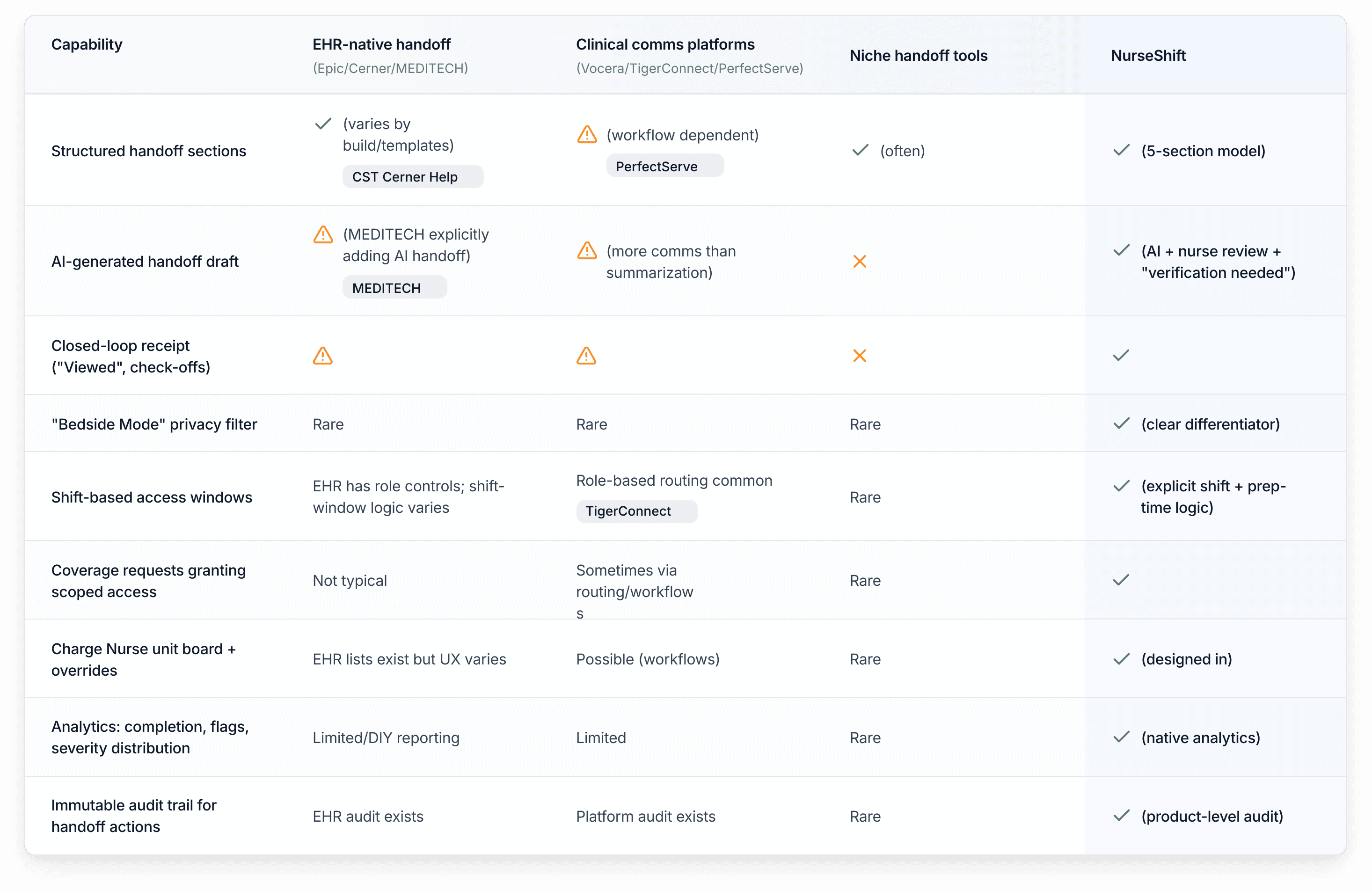
Competitive analysis
Available
Partial/Varies
Not Available
Roles and permissions
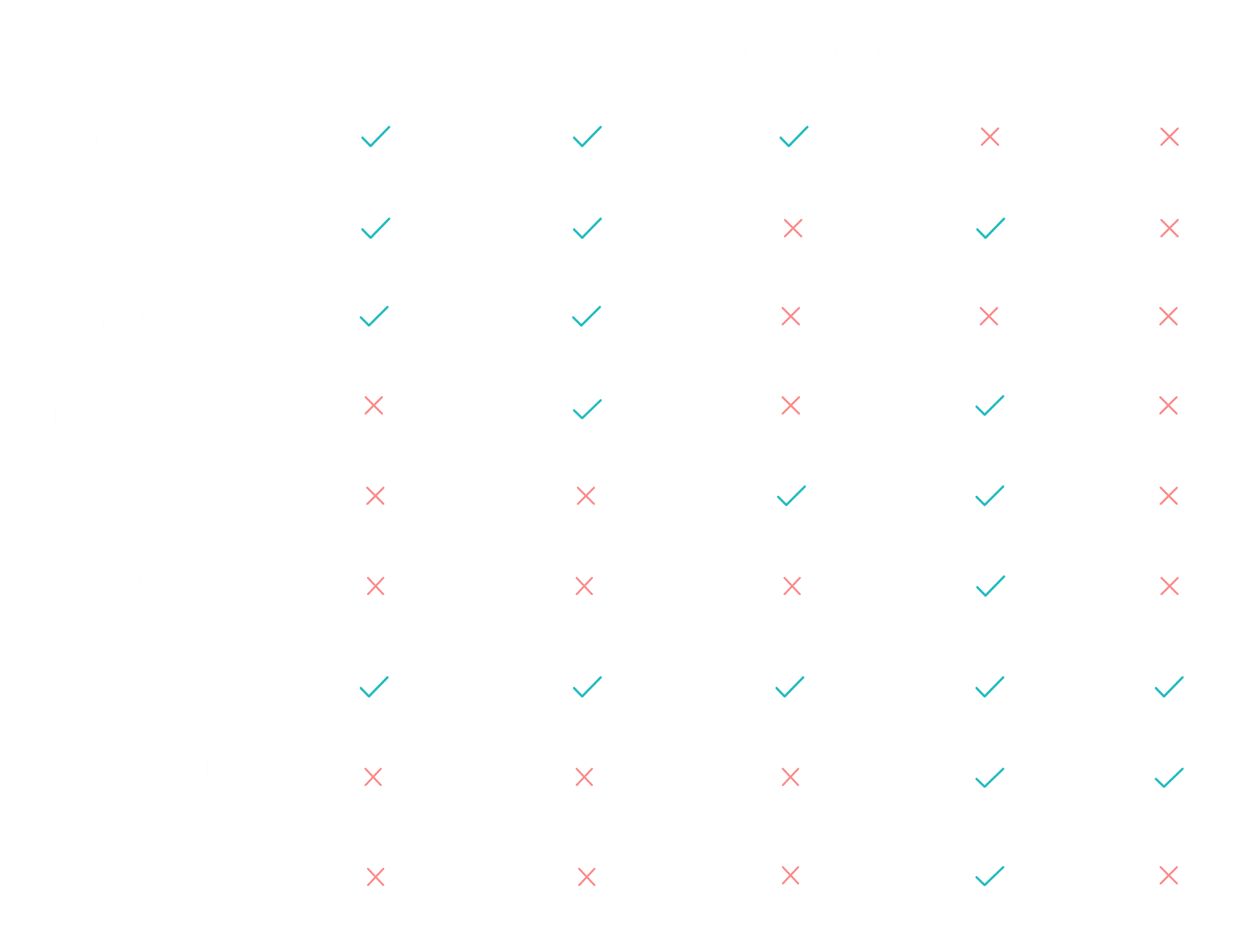
Understanding the Ecosystem, Not Just One User
Early exploration made it clear that handoffs don’t exist in isolation. They sit inside a clinical hierarchy:
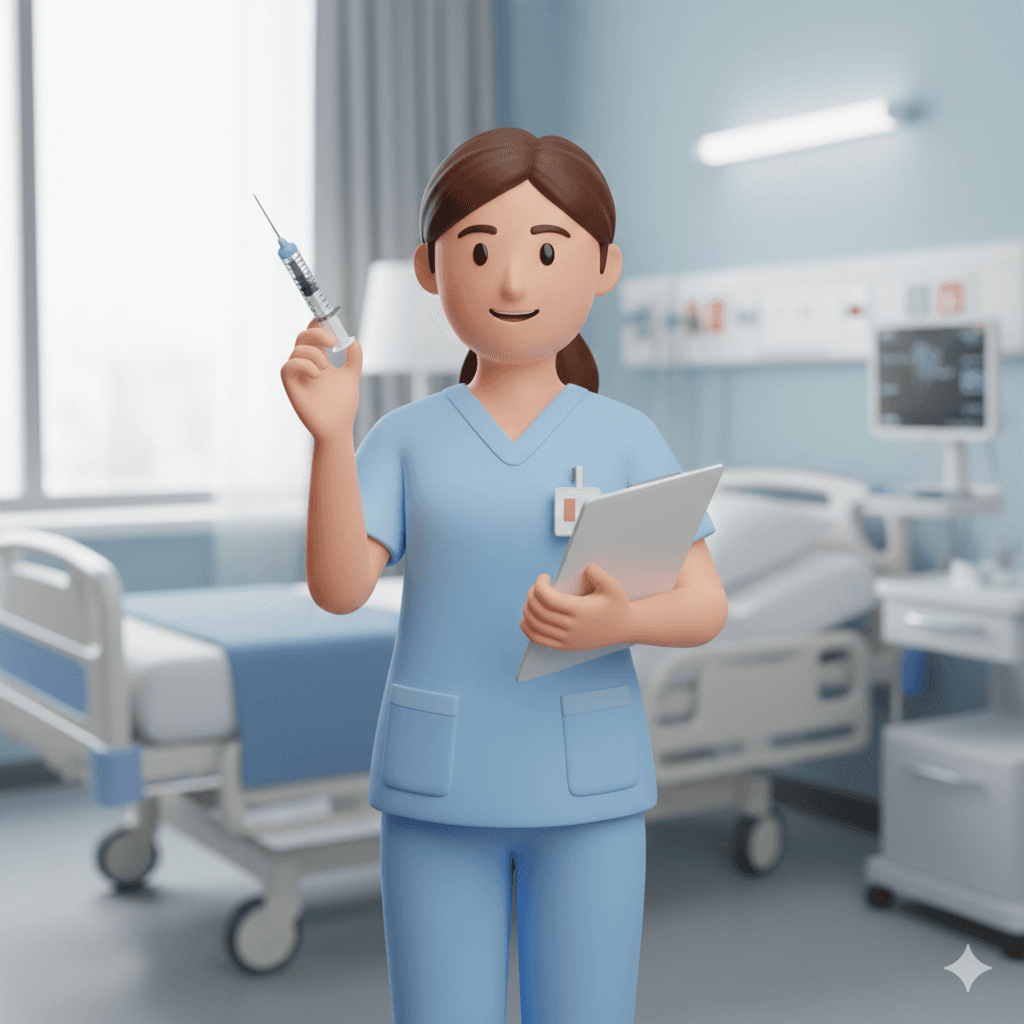
Bedside Nurse
Bedside nurses create and receive handoffs

Nurse Manager
look for patterns over weeks, not minutes

Administrator
Configure systems and ensure compliance

Charge Nurse
Monitor safety and staffing in real time
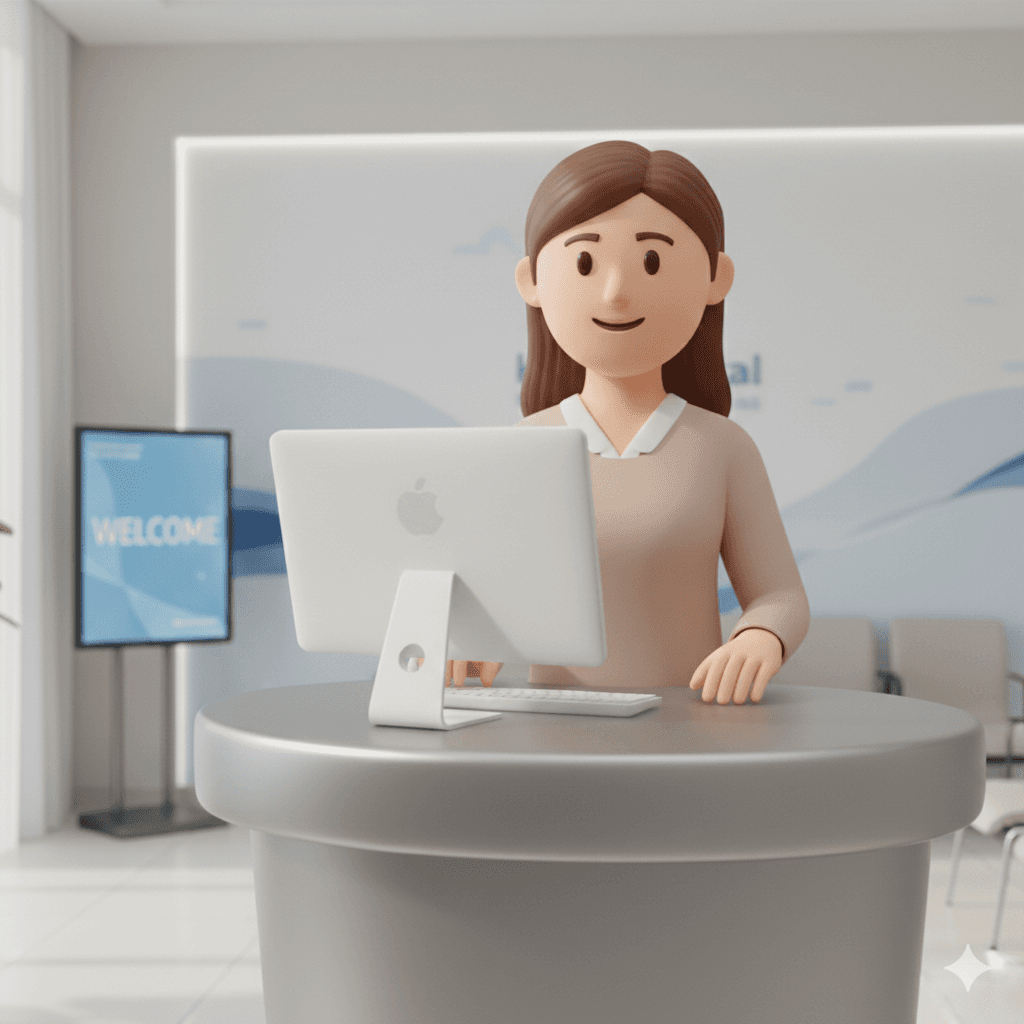
Receptionists
Getting patients registered
This led to a key UX insight:
A single interface cannot serve all users well.
Instead, NurseShift needed clear role boundaries, each with its own mental model and success criteria.
Design Challenge
How might we help nurses deliver complete, prioritized handoffs without adding documentation burden, while giving leadership the data they need to improve safety?
AI as a UX Design
Rather than asking “Where can we use AI?”, I reframed the problem:
Where do nurses experience the most mental fatigue?
The answer was consistently end-of-shift handoff creation.
AI was designed to:
Preserve nurse control and accountability
Surface uncertainty instead of hiding it
Create a first draft, not a final answer
This positioning helped build trust and encouraged adoption.
Personas
I created personas to understand the different goals, time pressures, and responsibilities of bedside nurses, charge nurses, nurse managers, and receptionists—reinforcing the need for clear role boundaries instead of a single shared interface.




Features
NurseShift integrates structured handoffs, AI support, real-time dashboards, and role-based workflows to reduce cognitive load and improve patient safety.
AI Draft Generate
2. AI Generate All Drafts
3. Request Coverage
4. Handoff
5. Guided Mode
6. App Tour
7. Add Shift Note
8. Needs Support
9. Patients Data
10. Assigning Patient to Nurse
11. Bedside Mode
12. Unit Board
13. Analytics Dashboard
AI Draft Generate
Generates a structured handoff summary for a single patient using notes, vitals, labs, and medications, while keeping nurses in full control to review and edit.
Design
NurseShift uses a clean, clinical UI focused on clarity, fast scanning, and reduced cognitive load—designed for high-stress healthcare environments where mistakes matter.
Visual Style
Primary Typography
Aa
Inter
Medium, Bold
Secondary Typography
Aa
Arial
Regular, Bold
Brand Colors
#09698C
#F1F5F9
#64748B
#E6F7FC
#EF4444
#FFFFFF
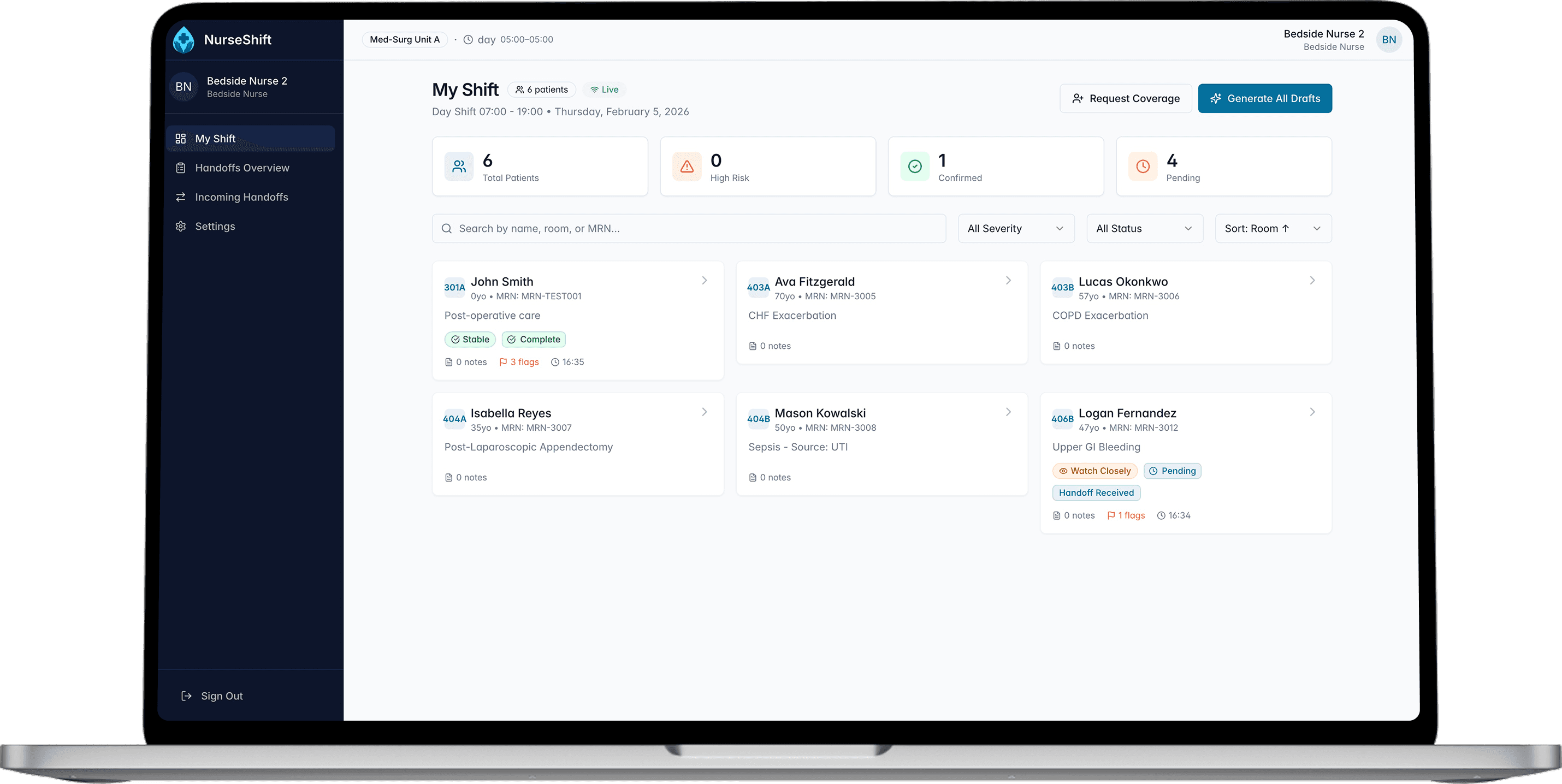
Bedside nurse: My Shift Dashboard
A shift dashboard enables fast scanning with live patient status, while patient details are organized into Overview, Notes, Handoff, and EHR. Incoming nurses review SBAR-structured handoffs, confirm receipt, and use Bedside Mode to hide private notes during patient interactions.
Charge Nurse: Unit Board
A real-time unit view groups patients by nurse, highlights high-risk and support-needed cases, shows live handoff completion status, and logs overrides and support flags for accountability.
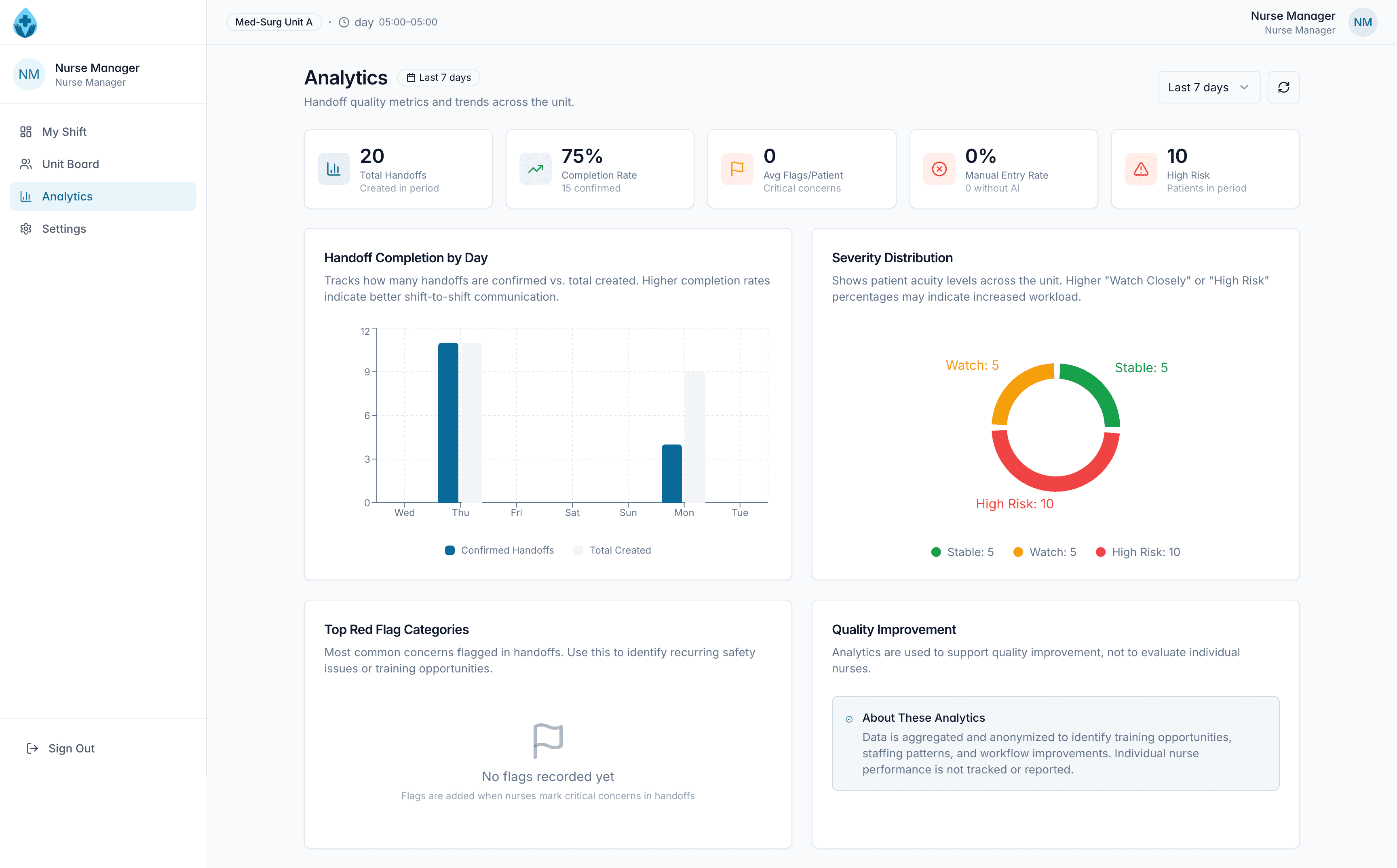
Nurse Manager: Analytics
Designed for patterns, not individual patients—surfacing handoff completion trends, severity distribution, common red flags, and AI vs manual handoff rates to support staffing, training, and quality improvement.
Administrator
Focused on configuration and compliance—managing users, roles, patient lifecycles, assignments, and audit logs, with clinical workflows intentionally removed to reduce confusion and risk.
Receptionist
A simplified, non-clinical workflow for admitting and discharging patients, with no access to clinical data and built-in guardrails to prevent errors.